Core Models Library
FM-2X
The FM-2X model is a 2-operator carrier/modulator FM kick. The carrier is a sub-bass oscillator with frequency controlled by PITCH and its CURVE, and amplitude controlled by ATTACK, SUSTAIN, LENGTH and VELOCITY as described in the Functions chapter.
The carrier operator itself is a wavetable oscillator, and COLOR controls the wavetable position:
To a square waveform in the counterclockwise position,
To a sinus waveform in the center position,
To a triangle waveform in the clockwise position,
And waveforms interpolation in-between.
The modulator operator modulates the frequency of the carrier to bring the transient typical of FM-based bass kicks. ATTACK will control the frequency modulation amount of the first operator to the second, while TRS DECAY controls the duration at which the frequency modulation will decay, from 10ms to 100ms.
The modulator operator is itself as well a wavetable oscillator, and TRS TONE controls the wavetable position, from counterclockwise to clockwise:
Square,
Derived Square,
Quarter Sinus,
Sinus,
Half Sinus,
Alternating Sinus,
“Camel” Sinus,
Positive Sinus,
And waveforms interpolation in-between. Those waveforms are similar to the OPL3 waveforms.
The ratio between the carrier frequency and the modulator frequency
can be adjusted in the model variations menus using the RATIO menu.
The possible ratio values are 0.5, 1 to 10, 12 and 15.
Another instance of those two operators is used for the Repetition sound source of the Groove expander.
HPN (Available Soon)
Note
Register now to get early access to HPN.
The HPN model is a wavetable oscillator kick combined with drum layering samples made from synthesized transients (FM hihats and FM snares), which sound “softer” than models like SP-6 or WT-4.
This model also completely redefines the Groove circuit compared to other models: instead of repetitions of the Bohm kick, Groove plays a random sequence of notes generated with the same wavetable oscillator as the kick, routed through a delay and an effects chain.
The wavetable oscillator is frequency-controlled by PITCH and its CURVE, and amplitude-controlled by ATTACK, SUSTAIN, LENGTH and VELOCITY as described in the Functions chapter.
The COLOR parameter controls the amount and duration of high frequency transients produced, by varying the wavetable position:
Fully counterclockwise, the wavetable oscillator is just a sinus
As the knob is turned clockwise, the oscillator sounds more distorted in the transient phase of the kick, but the tail remains a sinus
Fully clockwise, the wavetable oscillator only reaches the sinus position if the LENGTH is long enough
The wavetable waveform itself can be changed using the WT model variation menu. Drum layering samples can be changed using the LAYER model variation menu.
The Bohm FX menu also includes a new LPF option, in addition to the existing TUBE, BASS, SOFT, etc. When LPF is selected, FX controls the cut-off frequency.
The Groove circuit uses another instance of the same wavetable oscillator, sharing the Bohm COLOR setting, to play a random sequence of notes. Each CLOCK trigger advances the sequence by one step and produces the next note:
SEQ LENsets the length of the sequence, from 3 to 16 stepsSEQ SEEDselects the random seed used to generate the sequenceSCALEselects the musical scale the notes are drawn from (major, minor, chromatic, etc.)Groove LENGTH controls the length of each individual note
Groove PITCH transposes the entire sequence
Groove COLOR controls the range of sequence pitches and the cutoff of a low-pass filter, whose slope can be set to -24dB/oct or -12dB/oct using the
LPmenuSOFTENlimits the clickiness of each note
Important
Groove requires CLOCK to be triggered in order to produce sound.
The FX section is a delay followed by a selectable effect, which can be a COMB filter, a FILTER, or one of several Ohmicide-based distortions.
When an Ohmicide-based distortion is selected, two additional parameters become adjustable:
SHAPEselects the dynamics shape, fromSHARP(expander) throughNEUTRAL(no effect) toPHAT(compression)BODYsets the amount of compression or expansion
HZ-1
The HZ-1 model is a wavetable oscillator kick combined with a transient synthesizer.
The wavetable oscillator is frequency-controlled by PITCH and its CURVE, and amplitude-controlled by ATTACK, SUSTAIN, LENGTH and VELOCITY as described in the Functions chapter.
The COLOR parameter controls the amount and duration of high frequency transients produced, by varying the wavetable position:
Fully counterclockwise, the wavetable oscillator is just a sinus
As the knob is turned clockwise, the oscillator sounds more distorted in the transient phase of the kick, but the tail remains a sinus
Fully clockwise, the wavetable oscillator only reaches the sinus position if the LENGTH is long enough
The wavetable waveform itself can be changed using the WT model variation menu,
which a choice of “analog-style” waveforms.
The transient synthesizer type of click can be configured using the CLK
model variation menu, with a choice of different clicks, pops, ticks, and tocs.
Another instance of the wavetable oscillator is used for the Repetition sound source, but without the transient synthesizer.
OLP4
The OLP4 model is a 4-operator FM kick, insipired by the OPL3 chip. It is probably the most experimental model of the library.
The 4 operators are themselves as many wavetable oscillators, using the same
waveforms as described upper in the FM-2X model.
This time however, those waveforms are not interpolated and can be selected
using the WF1 and WF2 model varations menus:
WF1selects the waveform for operator 1 and 3,WF1selects the waveform for operator 2 and 4.
The operators can be arranged in different configurations called “algorithms”:
12: operator 1 into operator 2, then to out,1//2, operator 1 and 2 in parallel, summed to out,1234, operator 1 to operator 4 in serie, then to out,12//34, operator into operator 2, in parallel of operator 3 into operator 4, summed to out,1//234, operator 1 in parallel of operator 2 to operator 4 in serie, summed to out,1//23//4, operator 1 in parallel of operator 2 into operator 3 and operator 4, summed to out.
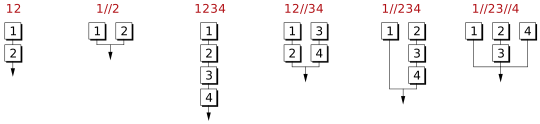
TRS TONE controls the amount of FM feedback from operator 3 to operator 1, which makes it more noisy. COLOR is inactive.

PM-K1
The PM-K1 model is a physical model of an acoustic bass drum.
This model is completely different from the others, and as such, all the parameters have a different meaning:
PITCH controls the size and tension of the bass drum,
ATTACK controls the volume of the beater, typically captured at the microphone dedicated hole,
TRS TONE controls the decay of the reverberation of the beater, leading to a more dark or brigther tone,
SUSTAIN controls the volume of the ambiant microphone, and LENGTH the size of the room,
FX controls the stereo spread of the ambiant microphone, from mono counterclockwise to wide clockwise.
All the other controls are inactive.
The Groove expander is not supported with this model.
PX3
The PX3 model is a wavetable oscillator kick with weird wavetables combined with drum layering samples made of various objects hitting diverse surfaces, post-processed with reverbs and distortions. It tends to sound “harder” and “more experimental” than most other models.
The wavetable oscillator is frequency-controlled by PITCH and its CURVE, and amplitude-controlled by ATTACK, SUSTAIN, LENGTH and VELOCITY as described in the Functions chapter.
The COLOR parameter controls a function which modulates the wavetable position.
The wavetable waveform itself can be changed using the WT model variation menu.
Drum layering samples can be changed using the LAYER model variation menu.
Another instance of the wavetable oscillator is used for the Repetition sound source, but without the drum layering sampler.
SP-6
The SP-6 model is a wavetable oscillator kick with “digital-sounding” wavetables combined with drum layering samples made from synthesized transients (FM hihats and FM snares).
The wavetable oscillator is frequency-controlled by PITCH and its CURVE, and amplitude-controlled by ATTACK, SUSTAIN, LENGTH and VELOCITY as described in the Functions chapter.
The COLOR parameter controls the amount and duration of high frequency transients produced, by varying the wavetable position:
Fully counterclockwise, the wavetable oscillator is just a sinus
As the knob is turned clockwise, the oscillator sounds more distorted in the transient phase of the kick, but the tail remains a sinus
Fully clockwise, the wavetable oscillator only reaches the sinus position if the LENGTH is long enough
The wavetable waveform itself can be changed using the WT model variation menu.
Drum layering samples can be changed using the LAYER model variation menu.
Another instance of the wavetable oscillator is used for the Repetition sound source, but without the drum layering sampler.
VX-T
The VX-T model is a wavetable oscillator kick combined with a transient synthesizer.
The wavetable oscillator is frequency-controlled by PITCH and its CURVE, and amplitude-controlled by ATTACK, SUSTAIN, LENGTH and VELOCITY as described in the Functions chapter.
The COLOR parameter controls the amount and duration of high frequency transients produced, by varying the wavetable position:
Fully counterclockwise, the wavetable oscillator is just a sinus
As the knob is turned clockwise, the oscillator sounds more distorted in the transient phase of the kick, but the tail remains a sinus
Fully clockwise, the wavetable oscillator only reaches the sinus position if the LENGTH is long enough
The wavetable waveform itself can be changed using the WT model variation menu,
which a choice of “analog-style” waveforms.
The transient synthesizer is a 4-operator FM based configuration, where TRS DECAY controls the amplitude decay, effectively leading in “toc” sounds counterclockwise and hihat sounds clockwise. The synthesizer is then fed to a band-pass filter for which TRS TONE controls the center frequency.
Another instance of the wavetable oscillator is used for the Repetition sound source, but without the transient synthesizer.
WT-4
The WT-4 model is a wavetable oscillator kick with “analog-sounding” wavetables combined with drum layering samples made from synthesized transients (FM hihats and FM snares).
The wavetable oscillator is frequency-controlled by PITCH and its CURVE, and amplitude-controlled by ATTACK, SUSTAIN, LENGTH and VELOCITY as described in the Functions chapter.
The COLOR parameter controls the amount and duration of high frequency transients produced, by varying the wavetable position:
Fully counterclockwise, the wavetable oscillator is just a sinus
As the knob is turned clockwise, the oscillator sounds more distorted in the transient phase of the kick, but the tail remains a sinus
Fully clockwise, the wavetable oscillator only reaches the sinus position if the LENGTH is long enough
The wavetable waveform itself can be changed using the WT model variation menu.
Drum layering samples can be changed using the LAYER model variation menu.
Another instance of the wavetable oscillator is used for the Repetition sound source, but without the drum layering sampler.
XT-88
The XT-88 model is a wavetable oscillator kick combined with drum layering samples, where the user can load their own wavetables and samples.
There are 2 folders on the sd card, wavetables and samples. The user
can place their files in the corresponding folder. Only the WAVE file format
is supported.
The wavetables must be in the following format:
Either generated from Xfer Records Serum or Serum 2, and a 2048 cycle length is assumed,
Or Mono, 32-bit float, and a 1024 cycle length is assumed.
Additionally, a maximum of 16 wavetables can be loaded, or until the wavetable 1.4 Mbytes dedicated memory is full.
The samples must be in the following format:
Mono or stereo
16-bit, 24-bit integer or 32-bit float
48kHz
Additionally, a maximum of 256 samples can be loaded, or until the sample 14 Mbytes dedicated memory is full.
The wavetable oscillator is frequency-controlled by PITCH and its CURVE, and amplitude-controlled by ATTACK, SUSTAIN, LENGTH and VELOCITY as described in the Functions chapter.
The wavetable waveform itself can be changed using the WT model variation menu,
and will display the loaded wavetables of the user.
COLOR controls the wavetable position. Then a modulated
EQ filter is applied to the output of the wavetable oscillator,
which brightness can be tuned using the BRIGHT model variation menu.
Drum layering samples can be changed using the LAYER model variation menu,
and will display the loaded samples of the user.
The LAYER VOL variation menu allows to change the layering sample volume.
Another instance of the wavetable oscillator is used for the Repetition sound source, but without the drum layering sampler.